Virasetu · from virasat (inheritance) and setu (bridge)
They spent a lifetime caring for you. Let us help you through what they left behind.
When someone you love passes away, the paperwork can feel endless. We help you find what they held, and guide you through each claim, one gentle step at a time.
Free to see what’s there. You pay only if you download the claim forms.
Finds what they held
Every bank, fund house and company, from two free statements.
Nothing leaves your device
Statements are read on your phone or computer. Never uploaded. How
Forms ready to sign
The standard RBI and SEBI claim forms, filled in for each institution.
Who are you here for?
For a family member who has passed away
See everything they held, who can claim each part, and get the claim forms filled in, ready for you to sign.
For myself: put your money in order, for the people you love
Find accounts and funds you may have forgotten, and set each one up so your family is never left searching.
See an example
How it works: walking through the paperwork with Ramesh Sharma’s family
Here is what his family would see, step by step, from adding his statements to sending the claims.
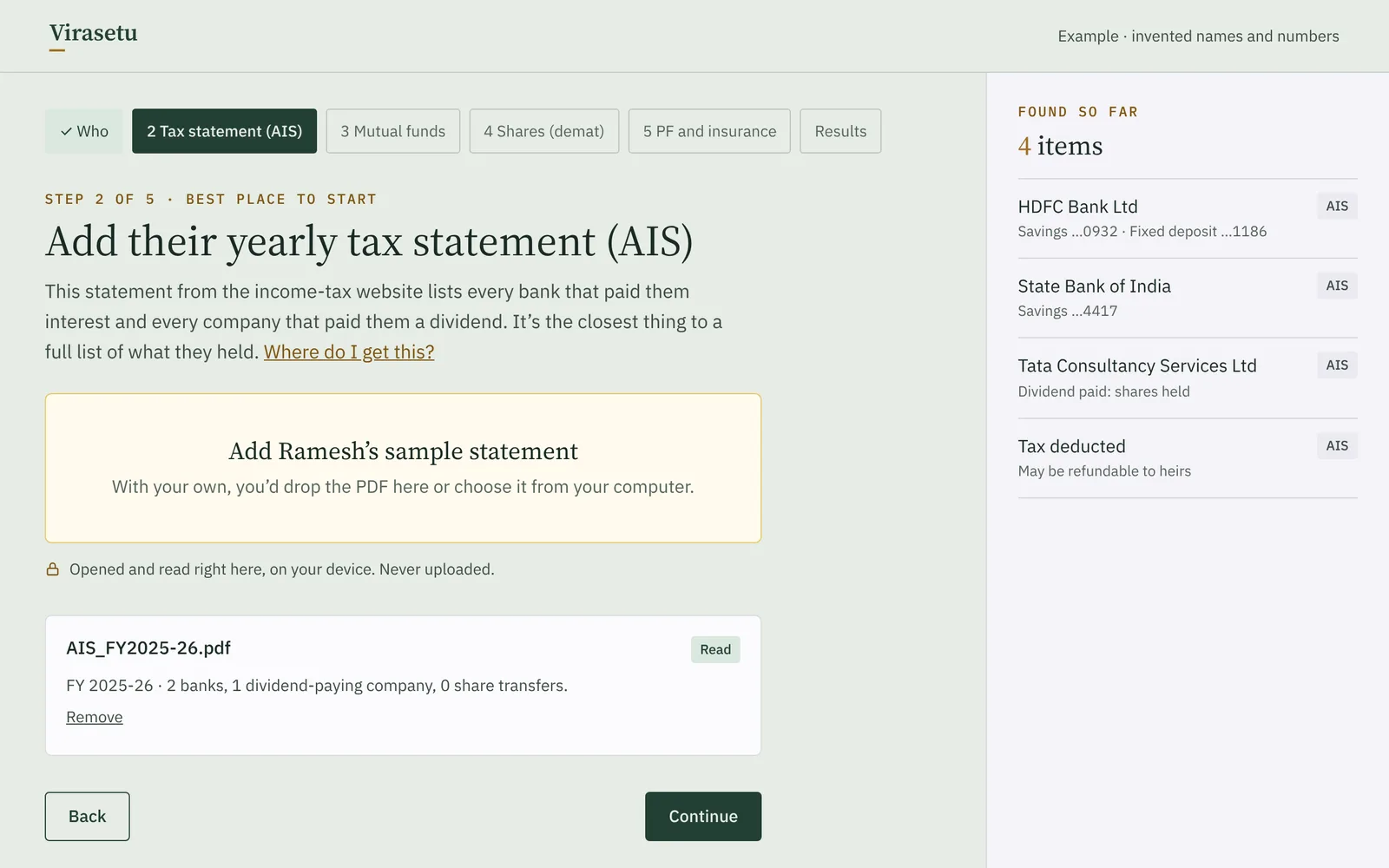
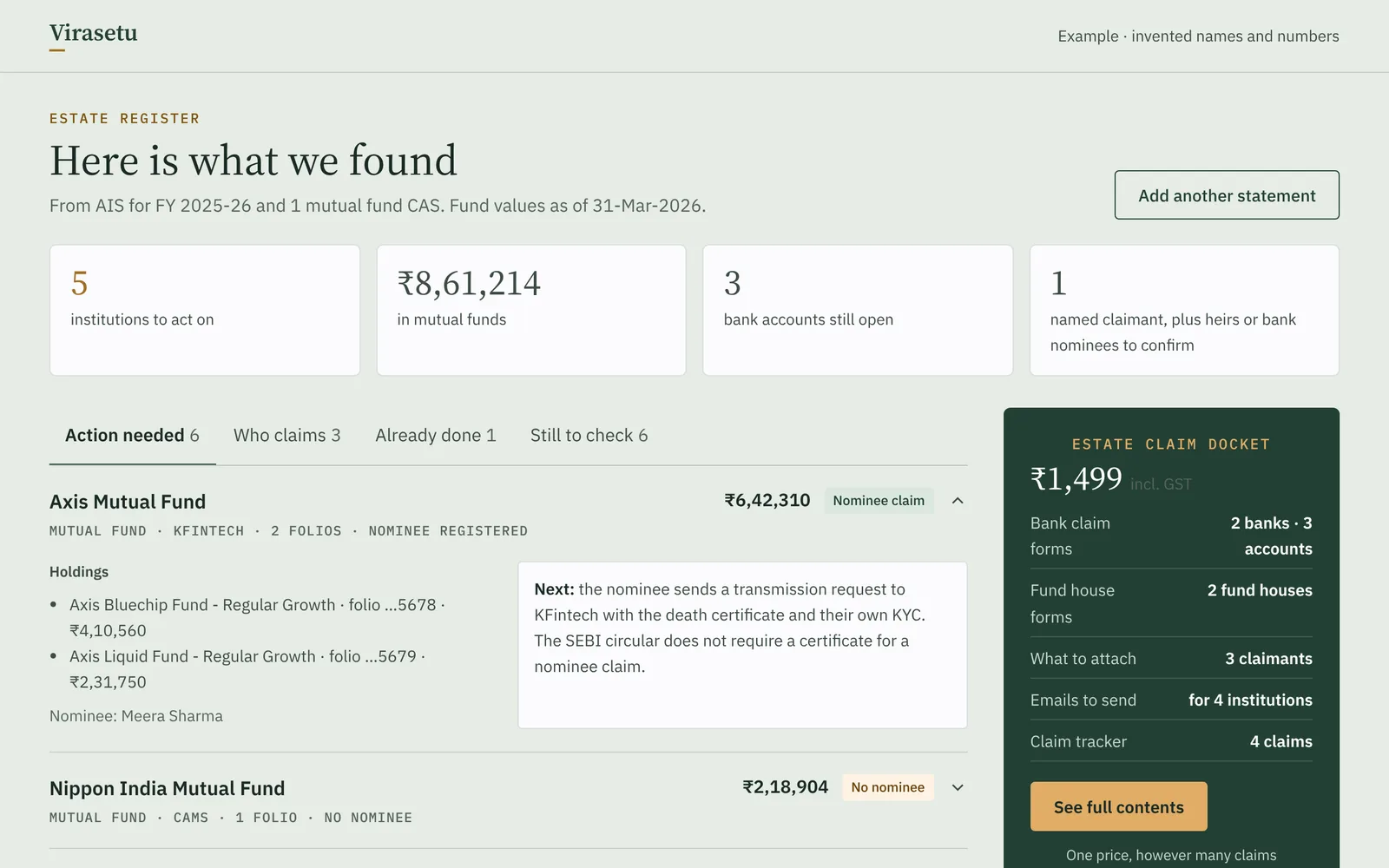
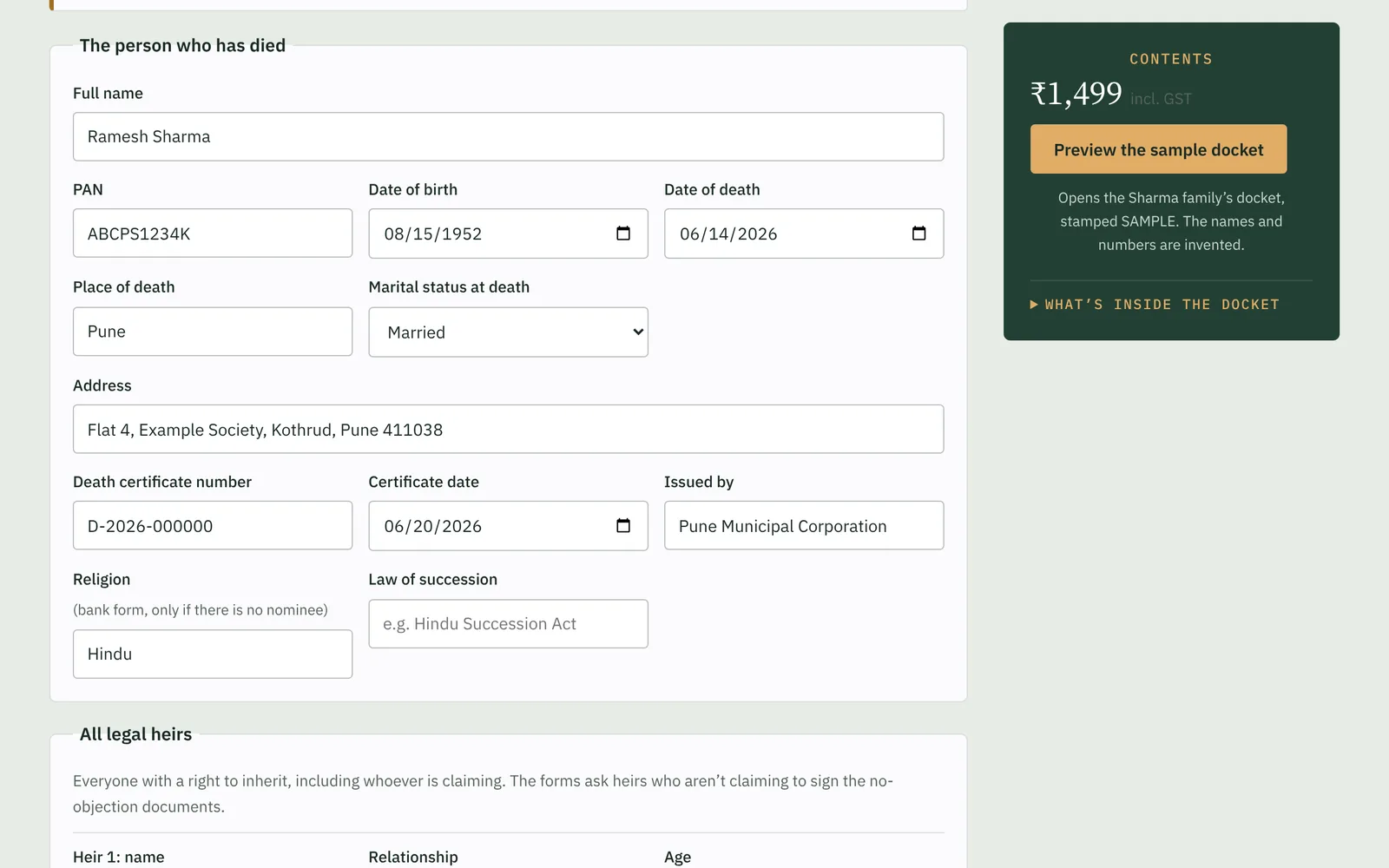
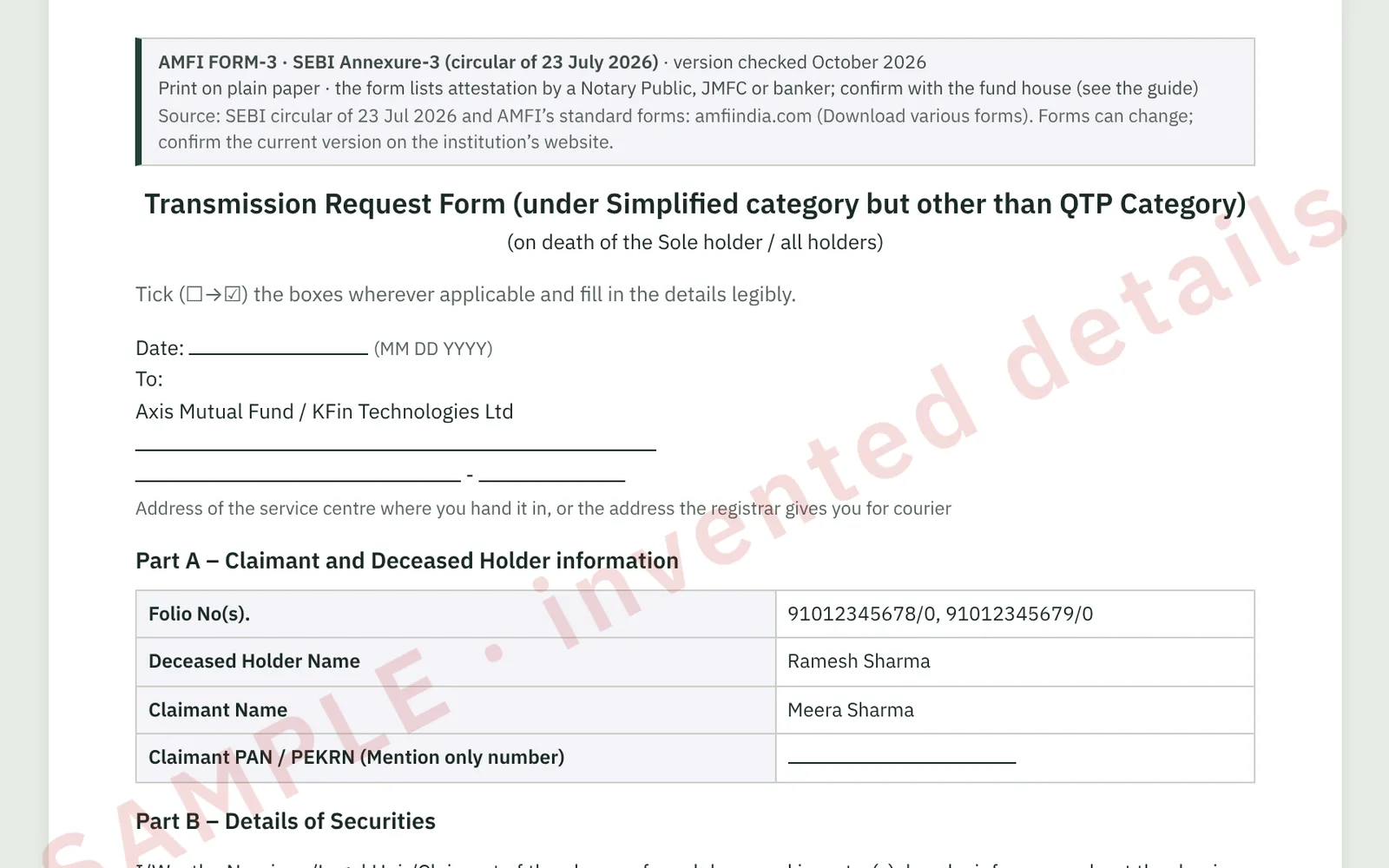
Add Ramesh’s sample statements and walk through the real app yourself. The names and numbers are invented.
Private by design
Your statements never leave your device.
Many online services upload your documents to read them. We don’t. The reading happens inside your browser, on your own phone or computer.
Your phone or computer
- Statements
- Their passwords
- Your money map
- Your claim forms
Opened, read and filled in here.
Our servers
Never receive your statements, passwords or the details you type. We keep only a payment record if you buy a docket, and your email only if you ask us to write to you.
See for yourself: once the app has opened, you can turn off your internet. It still reads your statements and fills in the forms, because nothing needs to go anywhere.
No account
Nothing to sign up for. To come back later, save your progress as a file on your own device, locked with a passphrase you choose.
No bank or portal passwords
You download the statements yourself. We never ask for net-banking, income-tax portal or card passwords.
You stay in control
You sign and submit every claim yourself. Nothing is sent to any institution on your behalf.
What we help you find
Money often sits in more places than anyone remembers. Here is what the statements show, and where we point you for the rest.
Read from the statements
Listed on your money map
- Bank accounts and fixed deposits: every bank that paid interest in the year, with the account type.
- Mutual fund folios: every folio across fund houses, its value and whether a nominee is registered.
- Shares: every holding in each demat account, with its value and whether a nominee is registered; companies that paid a dividend; and shares already transferred.
- Life insurance: policies in an e-Insurance Account, listed in the NSDL statement or typed in from the eIA.
- Tax deducted that may be refundable.
Official searches we point you to
For what statements don’t show
- Unclaimed bank deposits on RBI’s UDGAM portal.
- Unclaimed shares and dividends with the IEPF.
- Provident fund through the EPFO passbook.
- Older mutual fund folios through MITRA, run by CAMS and KFintech.
- Life insurance through each insurer’s unclaimed-amount search.
Pricing
You can explore everything before paying. Finding what’s there is always free. If you’re claiming for a family member, you pay once, and only when you download the claim forms.
Money map
Free
Read the statements, see every institution, and the official searches for the rest.
For yourself: action list
Free
What to fix at each fund house and bank (KYC, nominees, inactive accounts), with links to the official sites.
For a family member: claim docket
₹1,499
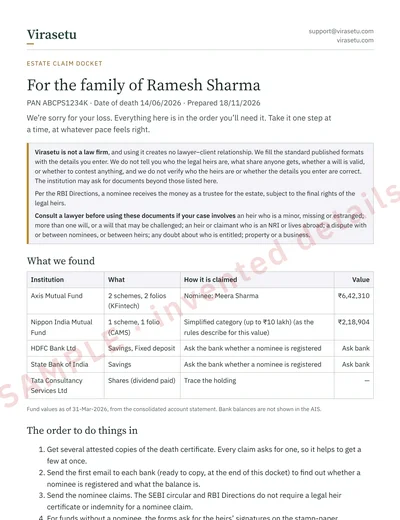
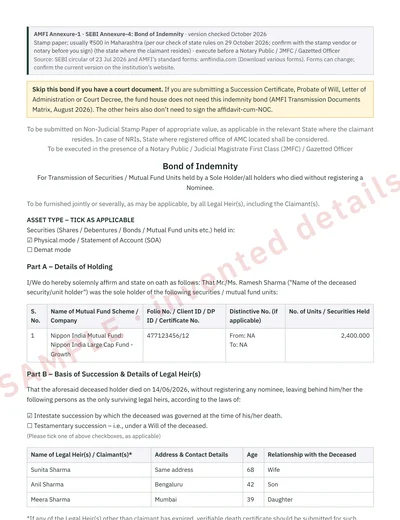
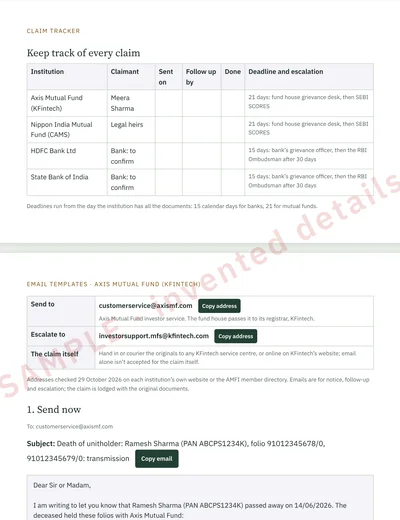
- The standard RBI and SEBI claim forms, filled in from the details you enter
- Indemnity bond and affidavit formats where the rules ask for them
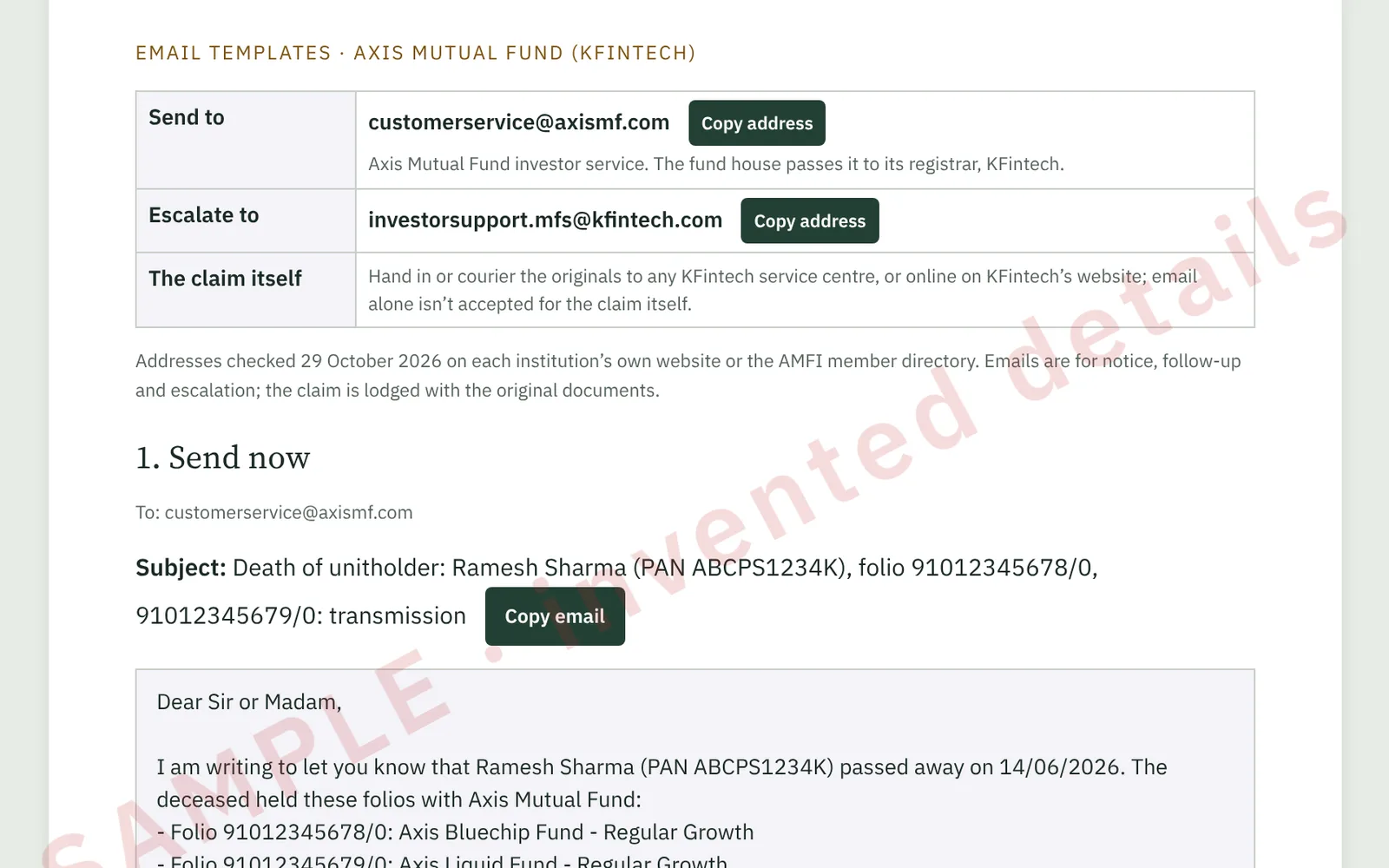
- What to attach, an email for each institution, and a tracker
See everything that’s in it, and what isn’t
Including GST. One payment for the whole estate. No subscription, and no share of the money recovered. See a sample docket
What’s in the ₹1,499 claim docket
Before you pay, the app shows exactly which forms are in your docket, for the institutions it found.
Included
- A cover sheeteverything found, who claims each part, and the order to do things in
- Bank claim forms, filled inin the RBI’s standard formats for each bank: the claim form, and the declaration, indemnity and affidavit where the RBI Directions list them
- Mutual fund and demat claim forms, filled inin SEBI’s standard formats: transmission request, Quick Transmission form, indemnity bond and affidavit-cum-NOC, for each fund house and demat account
- Your choice of documents, shown against the rulesfor each fund house and demat account, the set of documents SEBI’s rules describe for that value, and the one you chose
- Stamp paper and signing notesthe usual stamp paper value in your state, who signs each page, and who can attest it
- What to attach, for each claima checklist per institution and per claimant
- Emails, ready to sendfor each institution: the first notice, the acknowledgement request, the follow-up and the escalation, with the address to send each to
- A claim trackerwhen each claim is due, and where to escalate if it’s late
- When to speak to a lawyerthe situations where the family’s circumstances need one
Not included
- Legal advicewe don’t decide who the legal heirs are, what share anyone gets, or whether a will is valid
- Certificates from a court or tehsildarlegal heir or succession certificates. We show the process; you apply
- Stamp paper, notarising and submittingyou buy the stamp paper, sign in front of a notary, and hand in or send each claim yourself
- Insurer, PF and NPS claim formswe list the policies and accounts we find, and point you to each claim form
- Property, vehicles and locker contentsthese need separate processes, often with a lawyer
- A guaranteed outcomeeach institution decides on its own claim, and may ask for more
Fix or refund. If, within 30 days, a form we filled in turns out to be wrong or out of date because of our error, we correct it free within 5 working days. If we can’t, we refund the whole docket. Refund policy
See a sample docket From Ramesh Sharma’s example. The names and numbers are invented.
Questions
Do you access my bank or tax accounts?
No. You download the statements yourself and add them here. We never ask for net-banking, portal or card passwords.
Do you file the claims?
No, you sign and submit them yourself, so nothing happens without you. We fill in the standard forms with the details you enter, list what to attach and where to send each one, and give you a tracker.
There was no nominee. Can you still help?
Often, yes. Many families find themselves here. The RBI Directions and SEBI’s rules set out what a claim without a nominee needs, and that depends on the amount: for larger amounts it can include a legal heir certificate, a will or a succession certificate. The docket shows what the published rules list and fills in the forms. You choose which set of documents to prepare.
Is this legal or financial advice?
No. Virasetu is an information and document-preparation service, not a law firm. We don’t tell you who the legal heirs are or what share anyone gets. If an heir is a minor or abroad, there is more than one will, a dispute, or property involved, it’s worth speaking to a lawyer before you sign anything.
Which statements do I need?
The Annual Information Statement (AIS) from the income-tax portal is the best start. Then the mutual fund statement (CAS) from CAMS or KFintech, and the demat statement from NSDL, CDSL or the broker. All are free, and the app shows you where to get each one. If you can’t get one, skip it: the others still help.
What if something is wrong?
If a document we prepared is wrong or out of date, we fix it free, and if we can’t, we refund you in full. If you are charged but don’t get your docket, or are charged twice, we refund you in full. Because the docket is delivered instantly, we don’t refund a change of mind after download. See our refund policy.
Still have a question? Write to us at [email protected].